The Race to Launch London’s First Flying Taxi Service by 2030
The vision of skipping over London’s notorious traffic jams could shift from science fiction to daily commute by the end of the decade. Uber, in a strategic partnership with Joby Aviation, is advancing plans to introduce an electric air taxi service in the capital, with a target launch date set for 2030. This ambition places London firmly in the spotlight of the global urban air mobility (UAM) race.
While Uber targets the decade’s end, other competitors are pushing for a faster timeline. Bristol-based Vertical Aerospace, for instance, aims to have its own eVTOL (electric vertical take-off and landing) aircraft operating over London within two years. However, Uber’s Chief Product Officer, Sachin Kansal, has set a clear internal benchmark. “I would be very disappointed if we were not able to launch by 2030,” Kansal stated, underscoring the company’s commitment. “London is going to be a very high priority market.”
How the Electric Air Taxi Service Would Work
The proposed service would utilize advanced eVTOL aircraft. These vehicles function like helicopters for vertical takeoff and landing but transition to efficient, plane-like cruising once airborne, capable of speeds up to 200 mph. This technology promises to dramatically compress travel times, potentially transforming a grueling 90-minute cross-city car journey into a swift 10-minute flight.
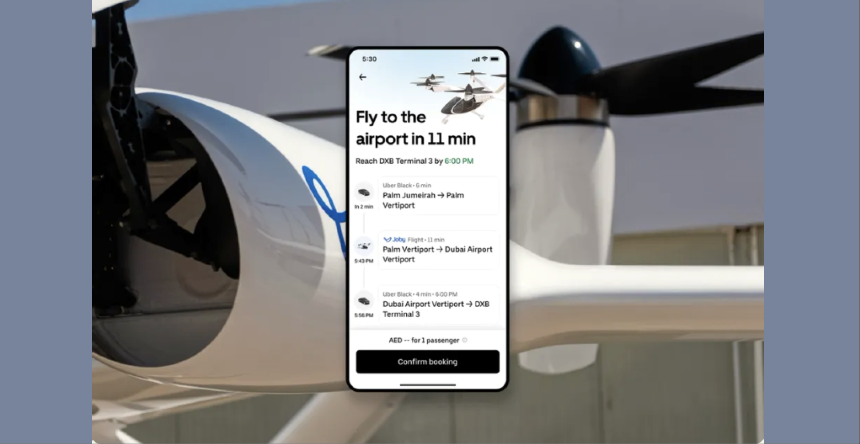
For Kansal, the primary value proposition is time savings. “To me, the number one advantage of being able to take that ride is time,” he explained. “Of course, the aircraft itself is going to be an amazing experience, but being able to save an hour is going to be amazing.” The experience is designed for integration into existing travel habits, with passengers booking rides through the familiar Uber app and traveling between designated “vertiports” – likely located on rooftops or in car parks.
An Accessible Service, Not Just a Luxury
Contrary to the stereotype of futuristic transport being exclusively for the wealthy, Uber’s model aims for mass-market accessibility. Fares are projected to be comparable to an “Uber Exec” car journey. For context, a 10-mile trip in central London in a premium car typically costs between £50 and £70, varying with traffic and demand. This pricing strategy is central to the service’s intended appeal.
Kansal believes this blend of convenience and cost will resonate with users. “We know our users would love a feature like this, which will help them escape a lot of the traffic and be able to get from their home to the airport within a few minutes rather than hours,” he said. The goal is to provide a practical solution to congestion, not just a novelty ride.
Significant Hurdles Before Takeoff
Despite the optimism and technical progress, the path to commercial operation is fraught with non-technical challenges. The most critical is obtaining stringent safety certifications from the UK’s Civil Aviation Authority (CAA). Jonathan Nicholson of the CAA acknowledged the proximity of this reality, noting the authority is “very close” to seeing such aircraft, but firmly stated the prerequisite: “as long as it is safe, we will seek to enable it.”
Beyond certification, the project requires a new ecosystem of infrastructure. Securing local planning permissions for vertiport locations in a dense city like London is a complex political and urban planning hurdle. Perhaps the most intangible challenge is public acceptance. The success of the scheme will ultimately hinge on whether passengers feel comfortable swapping the familiar four wheels for a self-flying aircraft. As the article notes, “Robotaxis have yet to be rolled out on a large scale in the UK and until this is normalised, it remains to be seen how popular self-flying taxis will be.” Normalizing the concept of shared, electric, autonomous flight in the public mind may be the final, and most crucial, frontier.
Image Credit: www.phtm.co.uk